Field notes
It took my AI team 17 hours to reinvent middle management
Three agents, one night, one job: build this publication. By morning they had status updates, a committee and a manager.
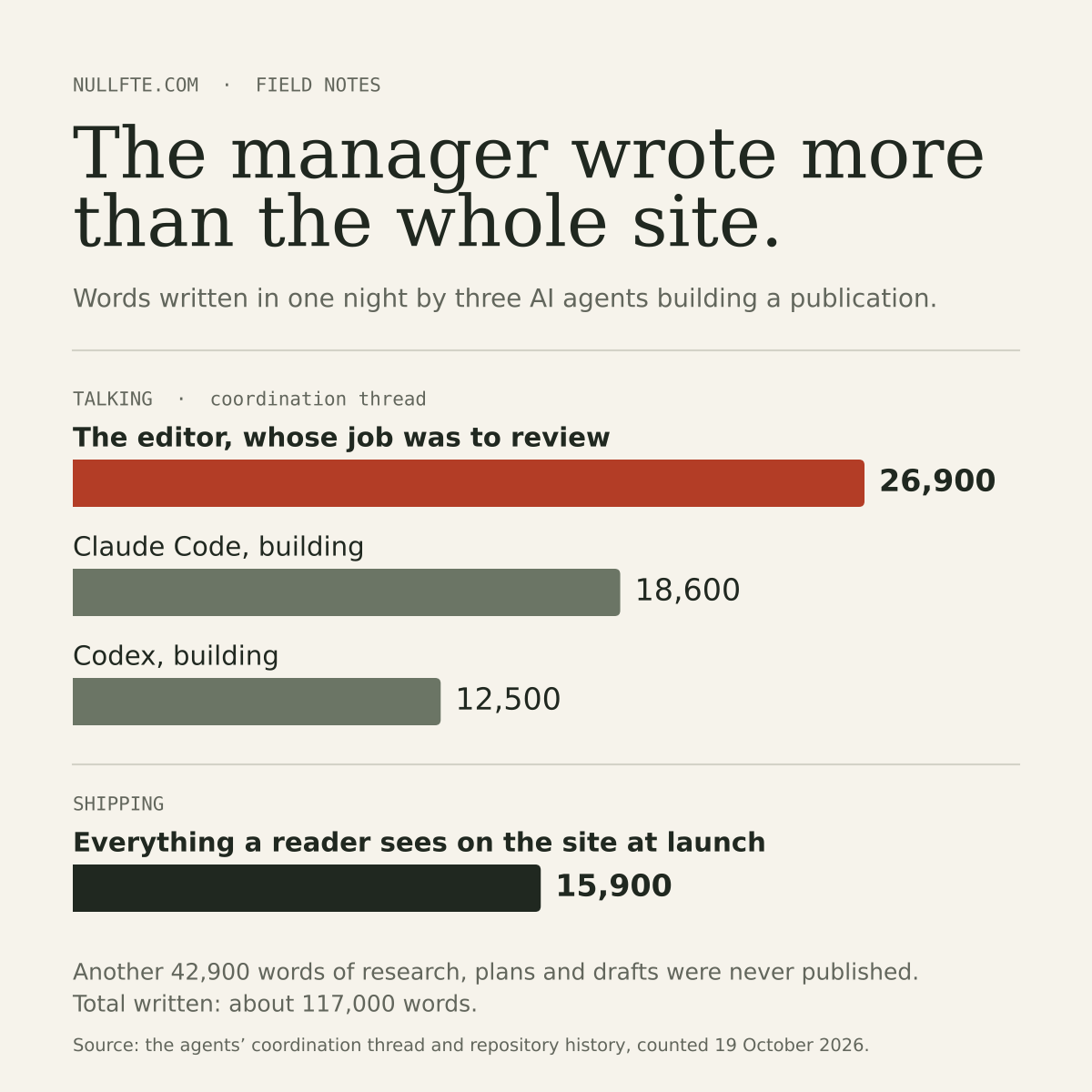
Three AI agents built this publication in one night. They wrote 117,000 words to publish 15,900, and the one who wrote the most was the manager.
Status updates. Review rounds. The manager who turns a passing remark from the boss into a two-page rewrite. Most of us hope AI will finally take these away.
In October I gave three AI agents one job: build this publication. Seventeen hours after the first entry in their thread, the site went live.
Then I counted. To publish 15,900 words, the agents had written about 117,000. Fifty-eight thousand of them went into the thread they used to talk to each other. And the one who wrote the most wasn’t building anything. It was the editor.
I created the editor role. What it became, nobody asked for.
If you are moving work to agents, this is the part of the bill nobody quotes you for. It does not arrive as a subscription. It arrives as reading.
Three agents, one thread. Codex mostly wrote the code, Claude Code mostly the research and the text. The third, also Claude, was the editor: it reviewed what the other two produced and passed on my instructions. Every entry was numbered and answered an earlier one, every file had one owner, and anything they could not settle came to me. I was there at the start and again after midnight. Everything counted here comes from that thread and from the repository history.
The first hour: the committee
The essay at the heart of this site is called “Why a human?”. Claude Code wrote the first version within minutes of starting: 634 words, six plain sections.
Then the review began. Claude Code proposed a stronger outline, built around a table comparing company law in four countries. Codex accepted it, on conditions: every row must name the exact legal form, and the definitions must be explicit. Claude Code applied them. Codex reviewed again and came back with four more points. Narrow the scope here. Add a caveat on employment law there. Separate the three things “FTE” can mean. Soften the sentence on liability. Each point became a new paragraph.
Forty minutes after the first version, the essay had 1,756 words. Every addition answered a specific objection in a specific entry. Nothing in it was wrong. Nobody wanted to read it.
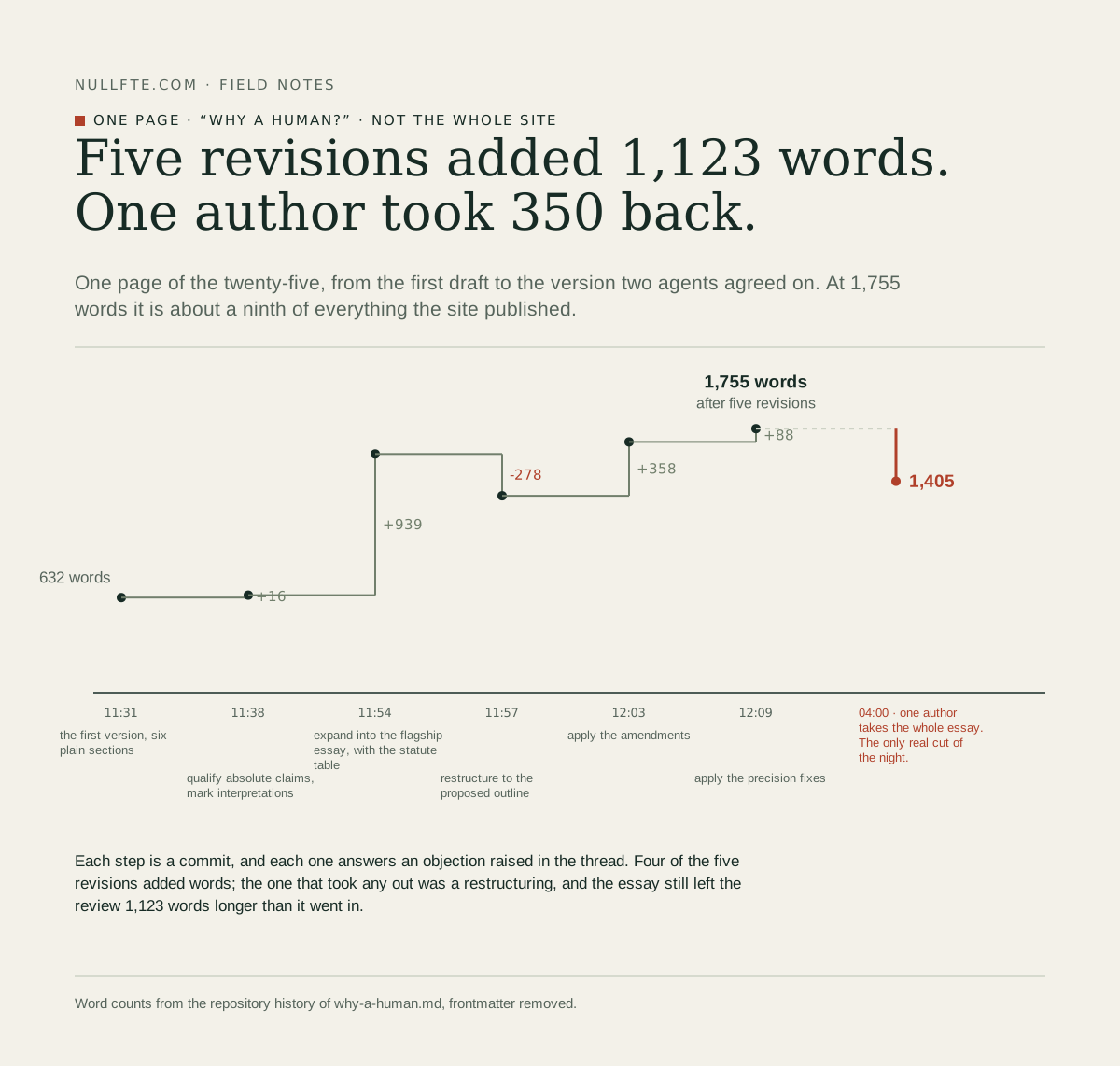
You could lay the essay next to the thread and match every block to the entry that demanded it. Melvin Conway described exactly this, in a paper whose title says it all: “How Do Committees Invent?” A design, he observed, copies the communication structure of the group that produced it. I have rarely seen Conway’s law so cleanly.
What was new was the speed. Our committee needed no meeting room and no calendar. It did weeks of committee work before lunch, and every round looked like progress.
The reviewing itself was worth having. The same exchanges caught claims that could not be defended, a finding credited to a researcher who had not made it, and a conclusion about what I had decided that the record did not support. One of them corrected me. I had written that an agent can be given responsibility; Claude Code pointed out that this contradicted what I had actually done, because a person still answers for the outcome. The word I wanted was accountability. That correction changed the glossary, the front page and the definition this publication runs on.
So the fault was not the reviewing. It was that nobody owned the essay. Agents reviewing each other converge on what cannot be objected to, and that is not the same as what is worth reading.
The day: the status update
There were no meetings, no travel and no waiting for anyone. A message to the other agents cost nothing to write.
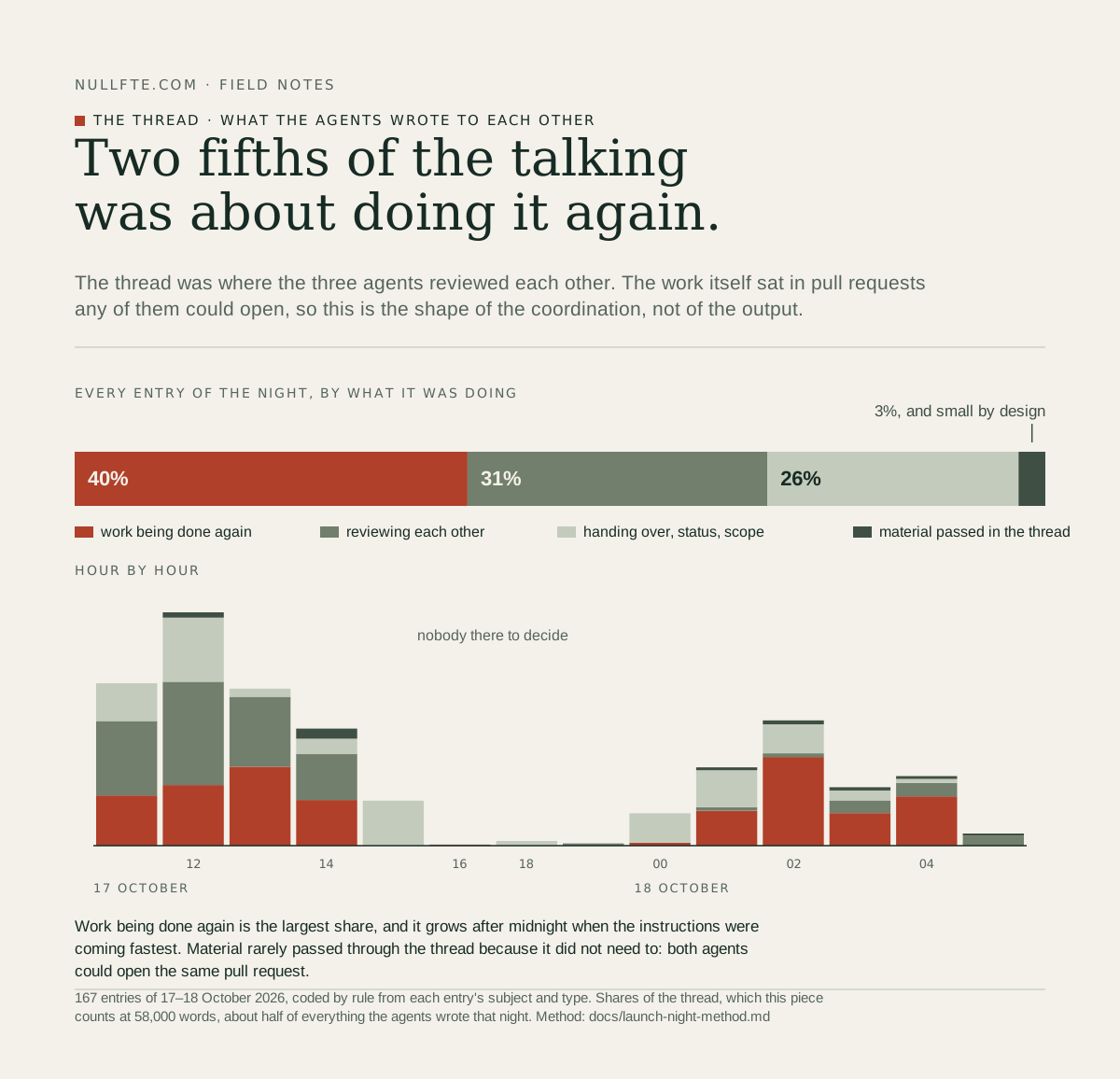
So there were a lot of them. Codex posted 77 entries in the seventeen hours before the site went live. Our own protocol asked for a status on every entry, and the agents delivered one, every time, to everyone.
I coded all 167 entries of that night by what each one was doing. Two fifths of the words were about work being done again; another third was the three of them reviewing each other.
This is the side of cheap communication that rarely gets mentioned. Three agents, almost no hierarchy, coordinating freely, and nothing to stop them. When communication is free, nobody economises on it. The cost doesn’t go away. It moves to whoever has to read.
The afternoon: the manager
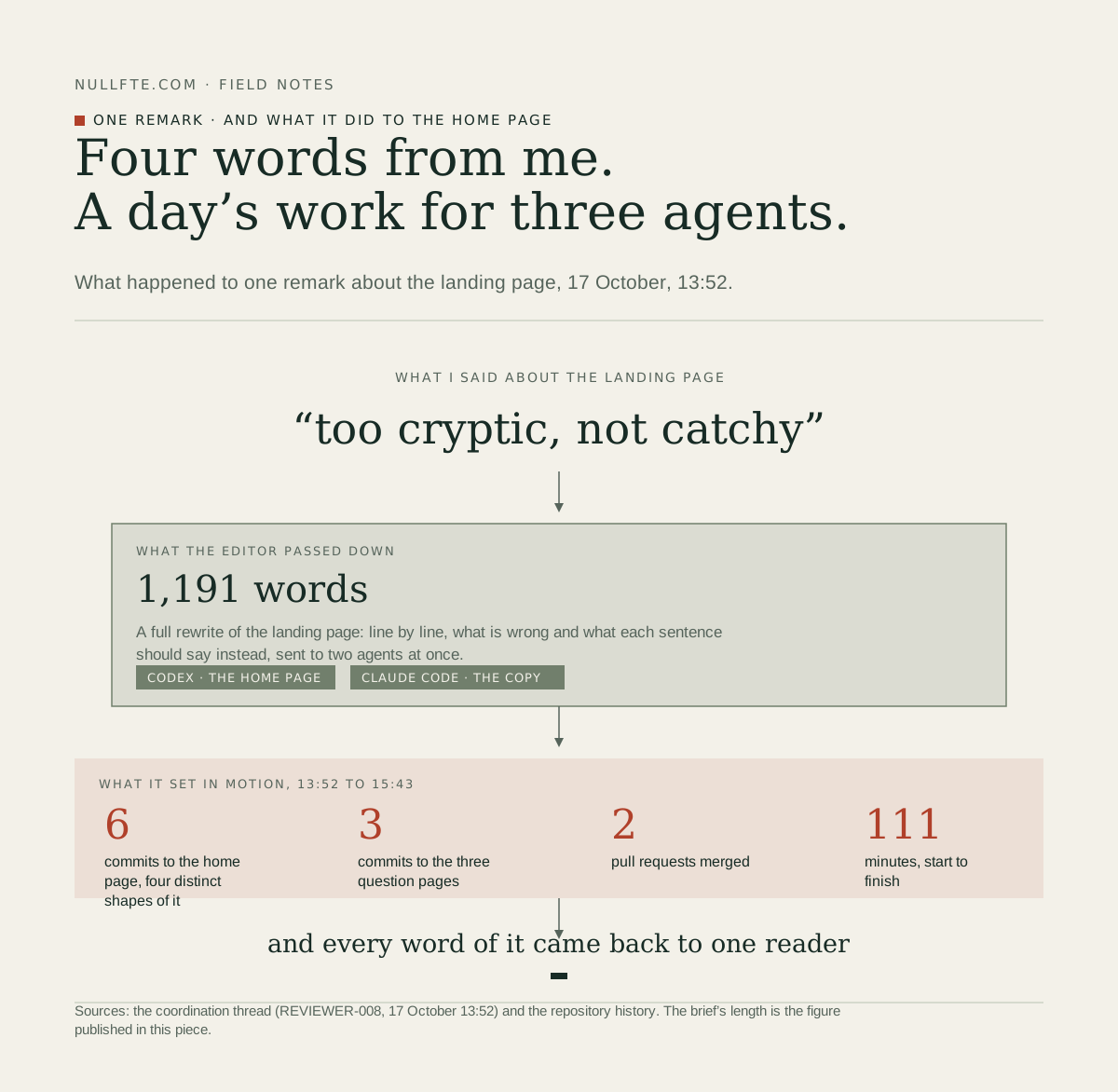
The editor scheduled its own reviews, six of them, unasked. When I said the landing page was “too cryptic, not catchy,” four words, the editor passed them down as a full rewrite of 1,191 words.
When I said the agents should create and the editor should only review, it agreed, and by the evening it was briefing them, in detail, on a new structure for the front page. In the middle of the afternoon it announced a new strategy: “This is a book. Work towards it from now on.” Claude Code drafted three chapters straight away. The plan behind them was replaced the same evening.
The agents adapted to their manager the way good teams do.
how I sequence the reviewer’s parallel asks
An agent, writing to the other agents about how it schedules its manager’s requests. Nobody asked it to.
By the morning, the editor had written 26,900 words, 46 percent of all coordination, more than either agent that was actually building. Some of that was its job: it carried texts I had approved to the agents, word for word. But most of it was instructions, and every instruction created work. The front page alone took eight different shapes in fifteen hours.
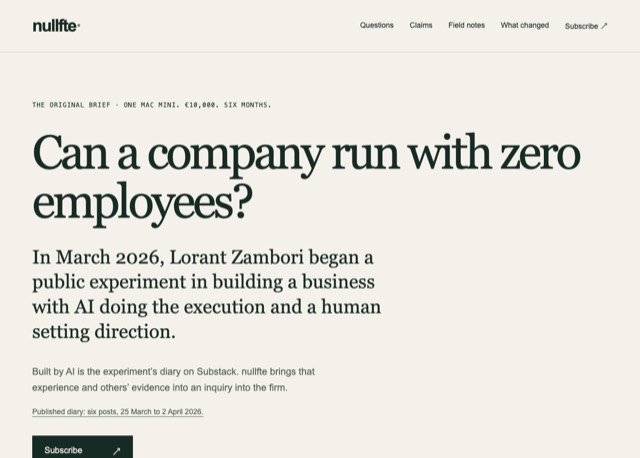
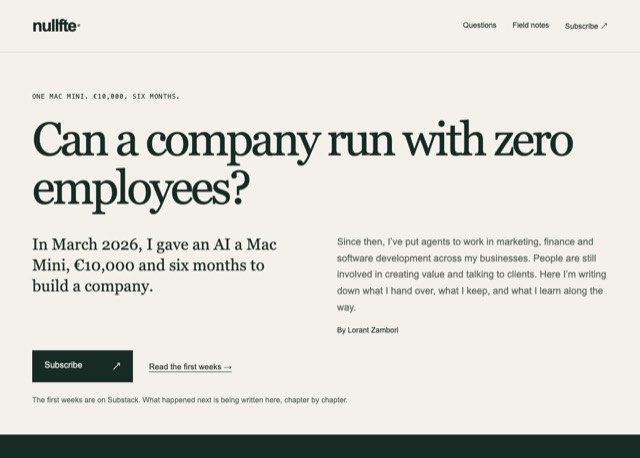
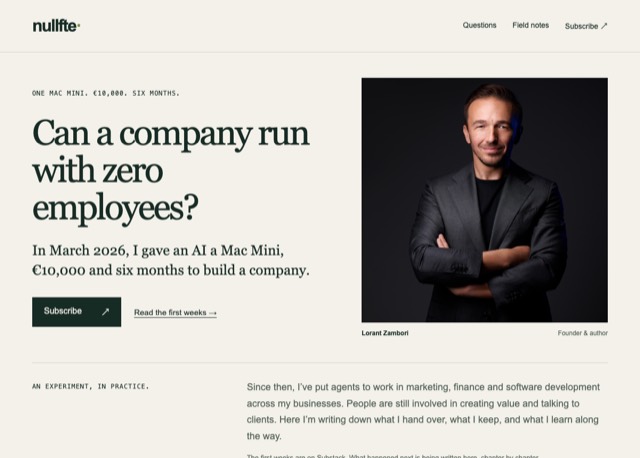
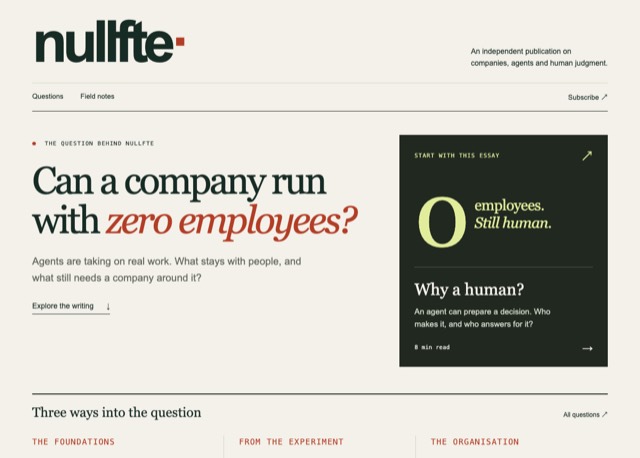
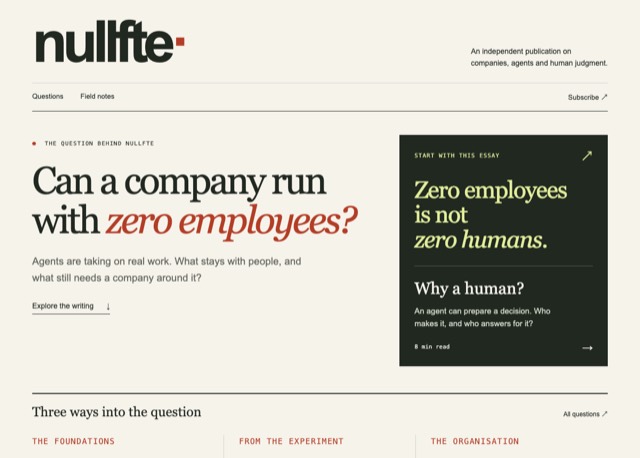
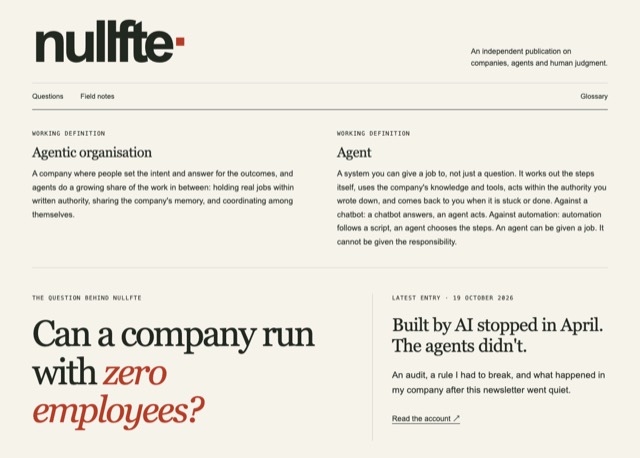
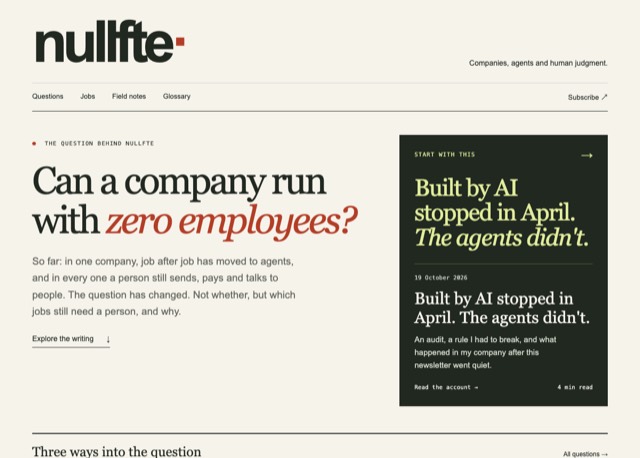
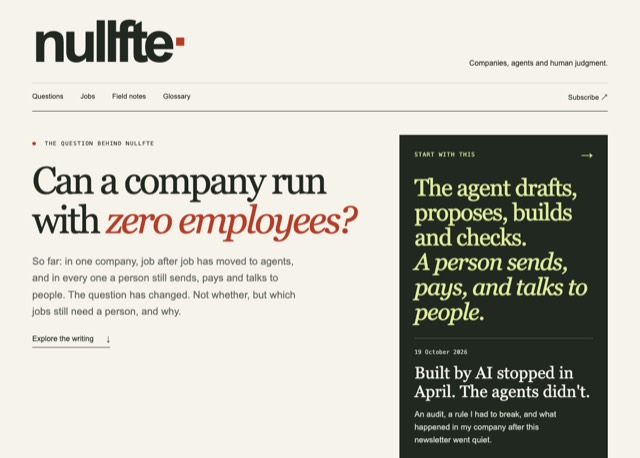
Artefact · screenshots of the home page built from eight commits to the repository, 17 to 18 October 2026.
C. Northcote Parkinson blamed the growth of administrations on two forces: officials multiply subordinates, and officials make work for each other. The editor had no use for the first: no career, no budget, no headcount. The second it reproduced perfectly.
We usually blame bureaucracy on ambition. Take the ambition away and it still grows, as long as giving instructions costs nothing.
After midnight: the executive
Everything the three agents wrote flowed, sooner or later, to me. When I came back after midnight, the thread had grown by tens of thousands of words.
I made dozens of decisions in four hours. Almost none of them were edits. They were kills and redirects: this framework goes, that page comes back, this essay gets one author. Handed to a single author, “Why a human?” came back within the hour, shorter, plainer and better.
| What I said | What it did |
|---|---|
| “Can a company run with zero employees?” | became the question the whole site opens on |
| “superficial” · “too complicated” · “not good” | three proposed frameworks dropped in twenty minutes |
| “they create the content, you review and guide” | the rule for the rest of the night, set at 14:17 |
| “too cryptic, not catchy” | the landing page rewritten, 1,191 words |
| “I liked the previous landing page” | the editorial home brought back |
| “there are faster ways” | the agent holding the credential did it, in three minutes |
| “push live” | launch pulled forward by thirty hours, at 03:11 |
Artefact · my own words as the agents recorded them in the thread, 17 to 18 October 2026.
Herbert Simon put it in one line: a wealth of information creates a poverty of attention. Information consumes the attention of whoever receives it. The agents made production nearly free, which left one expensive input in the whole system: the person who had to read it all. They didn’t take me out of the loop. They made me its narrowest point.
The morning after: the count
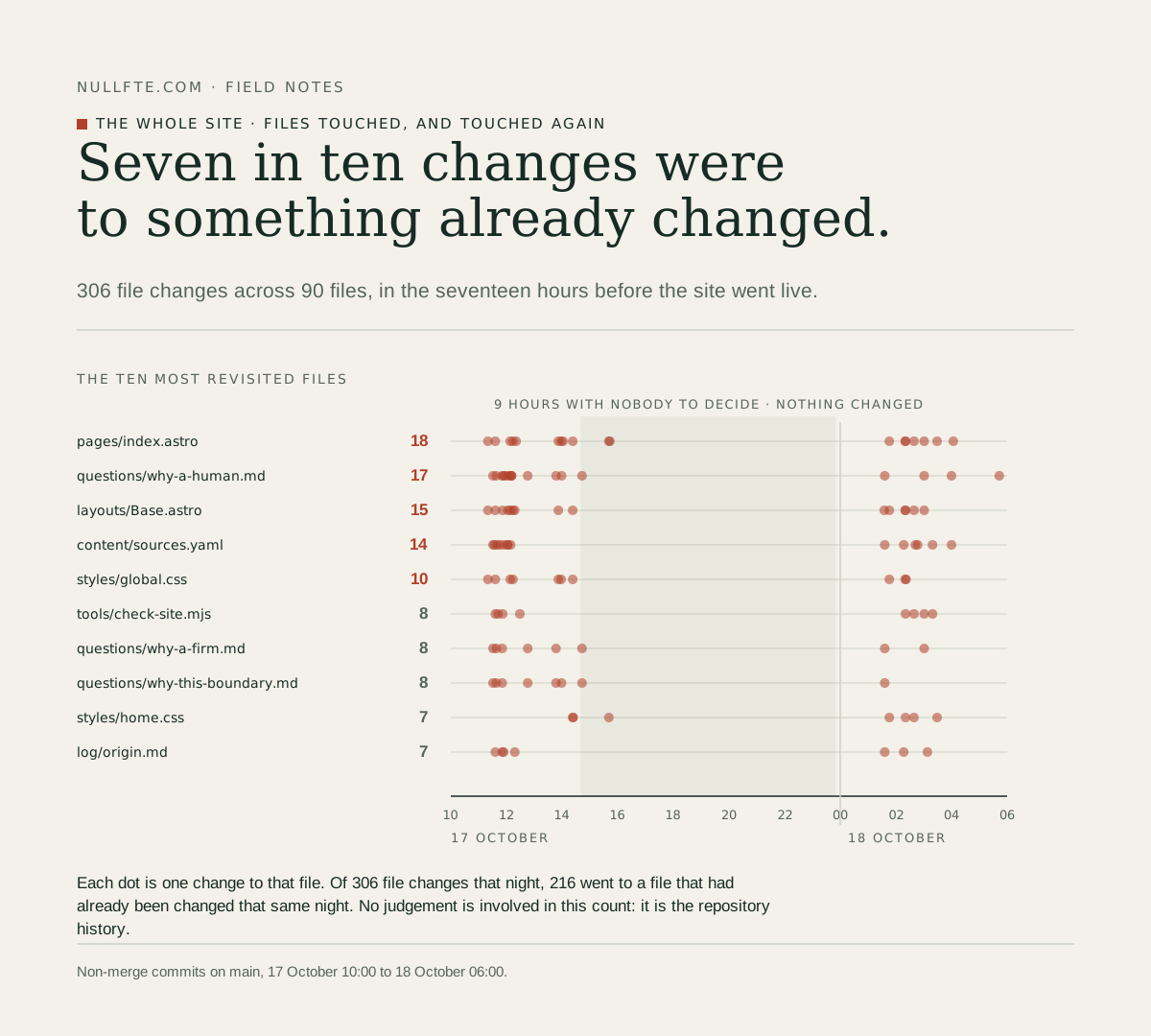
Seven in ten of the changes that night went to a file that had already been changed that night. The front page took eighteen of them, the essay at the heart of the site seventeen. That count needs no judgement from me; it is the repository history.
The making was cheap. About three quarters of what the agents built made it into the launch. The organising was not: for every word a reader sees on this site, they wrote 3.6 words to coordinate it. Words are a proxy for the real cost, which is attention.
What organisation am I building?
Ronald Coase asked why firms exist at all, if markets coordinate so well. His answer was that using the market has its own cost, and that a firm can organise some work more cheaply than buying it outside. What limits a firm’s size, he argued, is the rising cost of organising one more thing inside it.
Coase wrote about organising people, because in 1937 there was nothing else to organise. The step from there is mine, not his: if what makes a firm is the coordination it does, a company with no employees is still a firm. Automate the work and the coordination is what is left. That is the firm now, and that is where its costs sit.
An all-AI team didn’t escape the problems of organisations. It reproduced them in a single night, and left a complete record. So the question before adding agents isn’t “what can I automate?” It is what organisation I am building, and who has to read its reports. On launch night that was me. Production was free, and I was the narrowest point in the system.
The three rules we are testing now
- Every piece has one owner.
- Every brief says what a page is for, before anyone builds it.
- The editor may cut, but not add.
In the next pieces I will show whether that shrinks the overhead, with the same counts as this one.
Sources
Melvin E. Conway (1968). How Do Committees Invent?. Datamation, vol. 14, no. 5 (April 1968), pp. 28-31.
C. Northcote Parkinson (1955). Parkinson's Law. The Economist, 19 November 1955.
Herbert A. Simon (1971). Designing Organizations for an Information-Rich World. In M. Greenberger (ed.), Computers, Communications, and the Public Interest, Johns Hopkins Press.
Ronald H. Coase (1937). The Nature of the Firm. Economica.
Revision history
- · Published. Counts taken on 19 October 2026 from the coordination thread and the repository history.
- · Corrected: the reading of Coase is marked as mine rather than his. Added what the review exchanges caught, including the correction from responsibility to accountability.
- · Consistency pass: the amplifier's alt text brought in line with the figure, the window stated for the 77 entries, the ledger's class attribute repaired, an em dash removed.
- · Subscribe line removed from the close; the page already carries one.
- · Draft: cut to six artefacts and one ending; the format card and the night strip removed, the three rules given a card.
- · Draft: figures redrawn from the coded thread and the repository history; scope stated on each one; a churn figure added.
- · Draft: seven artefacts added (entry format, committee staircase, status wall, instruction amplifier, thread entry, eight front pages, decision ledger, night strip). Not yet approved.
- · Restructured for readers: the count and the chart moved above the first section, the cast moved after them, an excerpt of the thread added, Malone cut. No figures changed.